Fleetwatch
See the health, updates and security of every server in one place, and queue pre-approved fixes that verify themselves.
About
Overview
Fleetwatch is the operations software RG Interactive built to run its own infrastructure: hypervisors, virtual machines, containers and cloud servers across on-premises hardware and two cloud regions. One dashboard shows what is running, what depends on what, what needs updating and what is exposed.
Fleetwatch runs checks on a schedule for server health, pending updates, network vulnerability scans, application security and cloud spend. Every result is stored with its time, so each page shows the current state and how it got there.
When a check finds a problem, Fleetwatch matches it against a written rule book of fixes. Someone queues the fix from the page; a separate runner re-checks the problem, runs the fix and confirms the result. The dashboard itself never runs anything, and any fix that reboots a core server waits for approval.
Fleetwatch is built with Next.js, TypeScript and PostgreSQL. The checks and fixes are Ansible playbooks and Python scripts run by a self-hosted CI runner, and application security uses free, open-source scanners.
Media
Screens & stills
Highlights
What makes it work
The whole fleet on one map
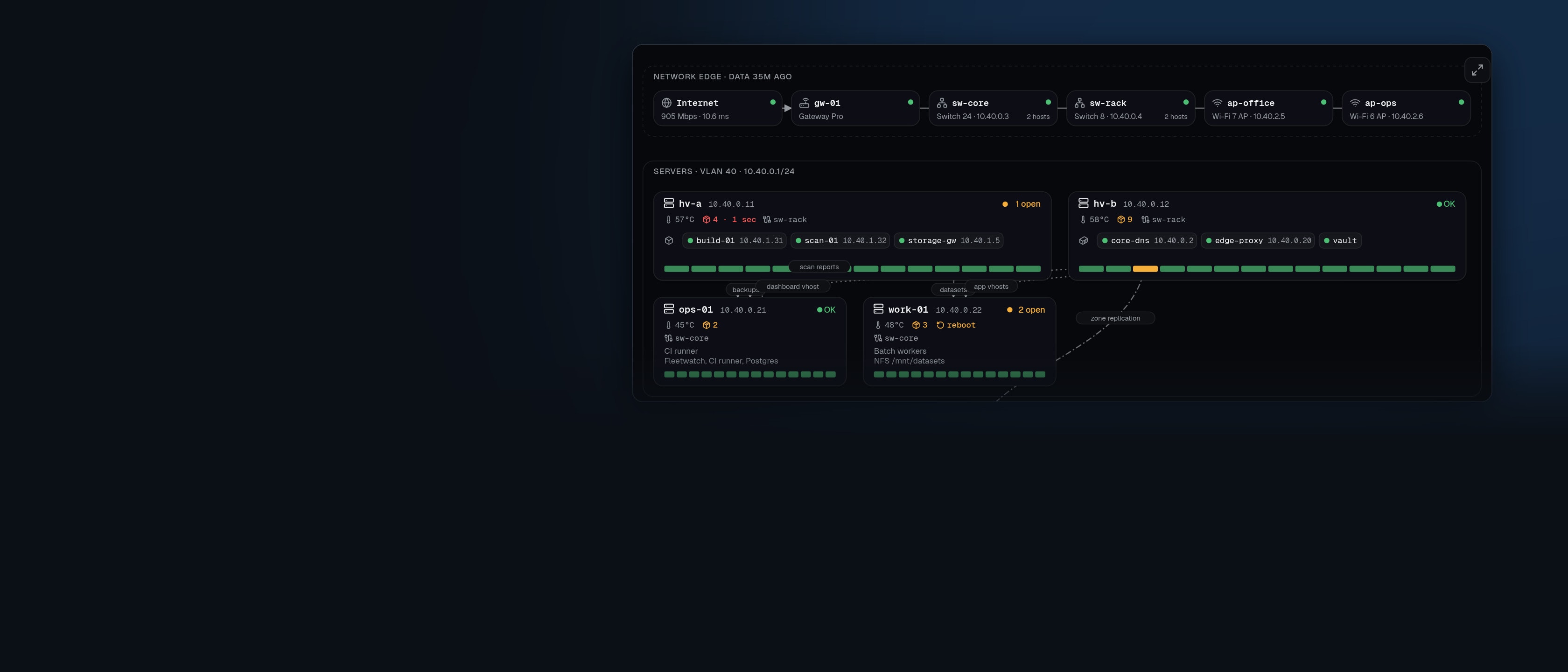
Every server, VM, container and network device on one map, with lines for what depends on what and a 14-day status history for each server.
Fixes from a rule book
Each fix is a reviewed playbook matched to a problem by rule. A runner re-checks before acting and confirms after; reboots of core servers wait for approval.
App security on a schedule
Open-source scanners check each app's code, dependencies, images, TLS and live site. New findings become tracked issues with a decision and a due date.
History, not snapshots
Every check result is kept with its time, so pending updates, vulnerabilities and storage each show a trend, not just today's number.
Have a project in mind?
Tell us what you're planning: a website, a game or a video. We'll reply with how we'd approach it, a rough timeline and a cost estimate.